

Blog
2026 Top Welded Wire Types for Global Buyers
The 2026 welded wire market is becoming more specialized, practical, and demanding. Global buyers now compare more than price. They assess strength, coating quality, weld consistency, packaging, and supplier reliability before placing an order.
This guide introduces the main welded wire types used in construction, agriculture, industrial protection, landscaping, and infrastructure projects. Galvanized welded wire offers dependable corrosion resistance for outdoor applications. Stainless steel mesh performs better in humid, chemical, or hygiene-sensitive environments. PVC-coated wire adds color and extra surface protection. High-tensile welded mesh supports projects requiring greater load performance and dimensional stability.
Small details matter.
A buyer may inspect weld spacing with a ruler, check coating thickness from test reports, or examine whether the rolls arrive without crushed edges. These practical checks often reveal more than attractive product photographs. Experienced suppliers should provide clear material grades, wire diameters, aperture sizes, tolerance data, production records, and realistic delivery information.
This overview follows common international purchasing concerns while recognizing that no single wire type suits every market. Local weather, installation methods, project standards, and maintenance budgets can change the best choice. A low-cost product may appear efficient, yet replacement costs can make it expensive later. That point deserves careful reflection.
The following sections compare welded wire forms, surface treatments, applications, quality indicators, and sourcing considerations for 2026. The discussion emphasizes verifiable specifications and field experience rather than vague sales claims. Buyers can use these insights to narrow suppliers, request appropriate samples, and select wire that performs reliably after installation. But specifications still need checking. Real projects are rarely perfect.
Welded Wire: Definition, Structure, and Core Manufacturing Methods
2026 Top Welded Wire Types for Global Buyers
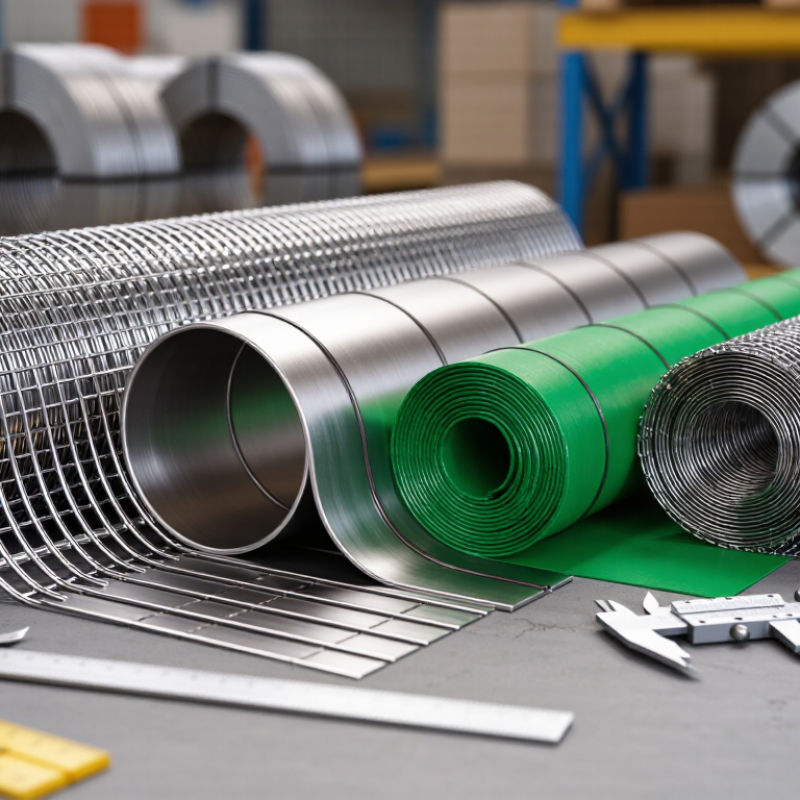
Welded wire is a grid of steel wires joined at fixed intersections. Longitudinal and cross wires create square or rectangular openings. The structure distributes loads more evenly than loose wire. Common types include plain, galvanized, stainless, and polymer-coated welded wire. Buyers should verify wire diameter, opening size, tensile strength, coating mass, and panel tolerance. These details affect corrosion resistance and installation speed.
Core manufacturing starts with low-carbon steel rod. The rod is drawn through dies to reach the required diameter. Straightening machines then remove coil memory. Resistance welding joins each crossing with controlled electrical current and pressure. After welding, panels may be cut, rolled, galvanized, or coated. ASTM A1064/A1064M provides widely used requirements for steel welded wire reinforcement. The World Steel Association’s World Steel in Figures 2025 reports about 1.88 billion tonnes of crude steel production in 2024. That scale supports broad raw-material availability, but it does not guarantee consistent mesh quality. Production reality is less tidy. Poor alignment can create weak intersections.
Tips: Request mill certificates and recent test reports. Check weld shear strength, coating thickness, aperture accuracy, and zinc adhesion. Compare samples from the panel center and edge. The International Trade Centre’s trade data can help buyers review regional import patterns and tariff classifications. However, classifications may group different wire products together. Treat market statistics as guidance, not proof of supplier capability. A factory audit remains useful, even when documents look complete.
2026 Top Welded Wire Types for Global Buyers - Welded Wire: Definition, Structure, and Core Manufacturing Methods
| Welded Wire Type | Definition and Structure | Common Material or Finish | Typical Wire Diameter | Common Mesh Opening | Core Manufacturing Method | Typical Applications | Key Buying Considerations |
|---|---|---|---|---|---|---|---|
| Plain Carbon Steel Welded Wire Mesh | Parallel longitudinal and transverse wires are arranged at right angles and joined at every intersection to form a rigid, flat grid. | Low-carbon steel, normally supplied mill-finish and uncoated. | Approximately 1.6–6.0 mm | Approximately 6–100 mm square or rectangular openings | Wire straightening and cutting or coil feeding, automatic positioning, and resistance welding at intersections. | Machine guards, partitions, cages, shelving, construction accessories, and general fabrication. | Requires a protective coating or indoor use when corrosion exposure is expected. |
| Electro-Galvanized Welded Wire Mesh | A welded carbon-steel grid with a thin zinc layer deposited electrically for improved surface protection. | Low-carbon steel with electroplated zinc coating; usually a smooth, bright finish. | Approximately 1.6–4.0 mm | Approximately 6–50 mm | The mesh is welded first, followed by electrochemical zinc deposition, rinsing, drying, and inspection. | Indoor partitions, light cages, storage systems, ventilation covers, and low-to-moderate humidity environments. | Confirm zinc coating mass and salt-spray or corrosion requirements; it is generally less corrosion-resistant than hot-dip galvanizing. |
| Hot-Dip Galvanized Welded Wire Mesh | A welded steel grid protected by a metallurgically bonded zinc-iron coating formed by immersion in molten zinc. | Low-carbon steel with hot-dip galvanized coating, either before or after welding. | Approximately 2.0–6.0 mm | Approximately 10–100 mm | Welding, cleaning and fluxing, molten-zinc immersion, cooling, and coating inspection. Post-weld galvanizing can cover weld areas more completely. | Outdoor fencing, agricultural enclosures, drainage covers, construction supports, and industrial platforms. | Check whether galvanizing is performed before or after welding, because coating coverage and appearance can differ. |
| PVC-Coated Welded Wire Mesh | A welded steel core covered with a continuous polymer layer that provides electrical isolation, color, and additional corrosion protection. | Usually galvanized steel core with PVC or another thermoplastic coating. | Core wire commonly 1.6–4.0 mm; finished diameter is larger after coating. | Approximately 12.5–100 mm | Steel wire welding, surface preparation, fluidized-bed or extrusion coating, curing, and adhesion inspection. | Garden fencing, animal enclosures, residential barriers, playground boundaries, and decorative panels. | Specify coating thickness, UV resistance, color stability, impact resistance, and the galvanized condition of the steel core. |
| Stainless Steel Welded Wire Mesh | A welded grid manufactured from corrosion-resistant stainless-steel wires, with clean intersections and no applied zinc coating. | Commonly austenitic stainless steel such as 304 or 316; 316 is generally preferred for chloride-rich environments. | Approximately 0.5–6.0 mm | Approximately 3–100 mm | Precision wire forming, controlled resistance welding, cleaning or passivation when specified, and dimensional inspection. | Food-processing equipment, chemical facilities, filtration supports, marine areas, architectural panels, and hygienic partitions. | Select the stainless grade according to chloride exposure, chemicals, temperature, cleaning agents, and required surface finish. |
| Welded Wire Reinforcement Mesh | A structural reinforcement grid made from cold-worked or deformed steel wires arranged in two directions and welded at intersections. | Carbon-steel reinforcing wire; plain or deformed wire may be used according to the applicable specification. | Commonly 4–13 mm, with heavier sizes available for structural work. | Commonly 100–300 mm; exact spacing depends on design and standard. | Wire drawing or rib forming, straightening, automated cross-wire placement, resistance welding, cutting, and bundling. | Concrete slabs, walls, pavements, precast units, tunnel linings, and industrial floors. | Specify design yield strength, wire area, spacing, sheet or roll format, lap requirements, and the governing structural code. |
| Heavy-Duty Welded Wire Panel | A rigid, large-format welded panel using thicker wires and stronger perimeter construction than light utility mesh. | Plain, galvanized, powder-coated, or stainless steel depending on the service environment. | Approximately 5–12 mm | Approximately 25–200 mm | High-current resistance welding, reinforced frame or edge treatment, surface finishing, dimensional checking, and palletized packing. | Security fencing, industrial cages, warehouse barriers, equipment guards, and heavy-duty partitions. | Evaluate panel stiffness, weld shear strength, post spacing, edge safety, impact loads, and installation hardware. |
| Fine Welded Wire Mesh | A close-opening welded grid made from relatively thin wires for separation, screening, and light containment rather than primary structural reinforcement. | Stainless steel, galvanized steel, or plain carbon steel. | Approximately 0.4–2.0 mm | Approximately 3–25 mm | Precision straightening, close-tolerance wire placement, low-distortion resistance welding, and flatness inspection. | Ventilation screens, laboratory equipment, small-animal cages, product racks, and light filtration supports. | Confirm opening tolerance, flatness, weld consistency, edge condition, and resistance to the intended cleaning or service environment. |
| Galvanized Welded Wire Fence Panel | A prefabricated fencing panel with welded horizontal and vertical wires, often incorporating narrow openings near the bottom for improved containment. | Hot-dip galvanized steel or galvanized steel with an additional polymer coating. | Approximately 3–8 mm | Commonly 50 × 100 mm, 50 × 200 mm, or graduated openings. | Automated panel welding, optional wire-end forming, galvanizing or polymer coating, panel cutting, and dimensional inspection. | Perimeter fencing, parks, schools, animal facilities, logistics sites, and property boundaries. | Check panel height, width, wire diameter, opening pattern, post compatibility, coating class, and local security requirements. |
| 3D Bent Welded Wire Panel | A welded fence panel with V-shaped or similar longitudinal bends that increase stiffness without requiring a fully solid frame. | Galvanized steel, often finished with polyester powder coating or PVC-based coating. | Approximately 4–8 mm | Commonly 50 × 100 mm or 55 × 200 mm, depending on the panel design. | Welded flat-panel production, precision bending or roll forming, surface coating, and dimensional verification. | Residential, commercial, sports, municipal, and industrial perimeter fencing. | Compare bend depth, panel rigidity, post system, anti-climb opening size, coating adhesion, and installation tolerances. |
Note: Wire diameters and mesh openings shown are common commercial ranges rather than universal limits. Final dimensions, coating mass, mechanical properties, and tolerances should be confirmed against the project specification and applicable national or international standard.
Related Posts
-
Why Choosing Welded Wire Mesh Fence Can Enhance Your Property Security
-
Top 10 Benefits of Using Welded Wire Mesh for Your Projects
-

Exploring the Top 5 Advantages of Welded Wire: Data-Driven Insights for Construction and Agriculture
-

7 Reasons Why Welded Wire Fences Are Essential for Security and Durability
-

Evaluating the Benefits of Welded Wire Mesh Fence Against Traditional Fencing Solutions
-
How to Choose the Right Welded Wire Mesh for Your Construction Projects