

Blog
How to Choose the Best Spotlight LED Lights?
Choosing Spotlight Led Lights involves more than comparing brightness or price. A beam that looks crisp in a shop can feel harsh above a kitchen counter. The right choice depends on the space, the task, and the fixture. Consider light output, beam angle, color temperature, dimming compatibility, and heat management before buying.
Energy performance matters, too. The U.S. Department of Energy reports that residential LED bulbs use at least 75% less energy and can last up to 25 times longer than incandescent lighting. These figures offer useful context, but they are not a guarantee for every spotlight. Product quality, operating conditions, and compatibility can affect real-world results. Check the manufacturer’s specifications and warranty. Small details count.
This guide explains how to compare spotlight types and match their beam patterns to practical uses, from highlighting a framed photograph to lighting a hallway. It also looks at brightness, color rendering, installation, and running costs. A narrow beam can create a dramatic pool of light; a wider one may suit general illumination better. Neither is automatically best. Even careful choices involve trade-offs, and a specification sheet cannot show exactly how light will feel in your room. DOE guidance is a starting point, not the whole decision.
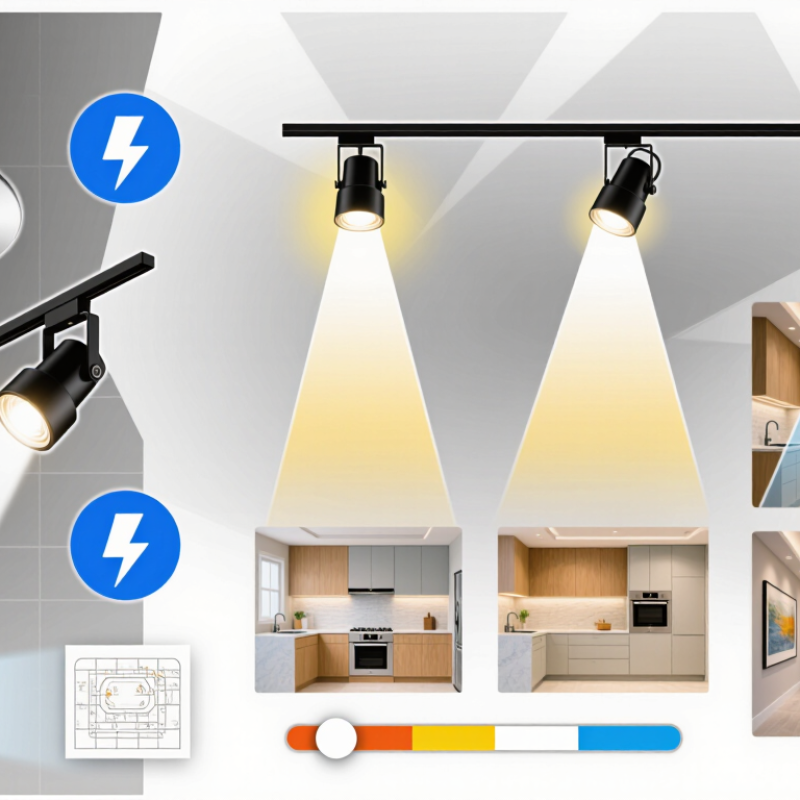
What Spotlight LED Lights Are and How They Work
How to Choose the Best Spotlight LED Lights?
What Spotlight LED Lights Are and How They Work
Spotlight LED lights are directional lamps that concentrate light on a specific area. Unlike traditional bulbs, an LED chip produces light when electric current passes through a semiconductor. A driver regulates the current, while a heat sink helps move heat away from the chip. The lens or reflector shapes the beam, creating a focused pool on a kitchen counter, artwork, or garden path.
Beam angle affects how that light spreads. A narrow beam highlights a small object; a wider beam covers more of a wall or room. The U.S. Department of Energy’s Energy Saver guide reports that LEDs use at least 75% less energy than incandescent lighting. It also says they can last up to 25 times longer. These comparisons are with incandescent lamps, not every modern light source. A narrow beam can still feel harsh.
Tips: Check lumens for brightness, beam angle for coverage, and color temperature for the mood you want. Look for a stated CRI if accurate color matters. Confirm dimmer compatibility before installation. If possible, test the light on the actual surface; a bright center may leave nearby corners dim.
| Selection Factor | What It Means | How It Affects the Light | Practical Selection Guide |
|---|---|---|---|
| LED light source | A semiconductor converts electrical energy into light when current flows through it. | LEDs produce light efficiently and generate heat that must be managed at the LED junction and heat sink. | Choose a fixture with suitable output, a well-designed heat sink, and a stated operating temperature range. |
| Optics and reflector | A lens, reflector, or combination of both directs and shapes the light emitted by the LED. | Optics determine beam spread, distribution, and how sharply the light is focused. | Look for an adjustable or replaceable beam option if the target or mounting position may change. |
| Beam angle | The approximate angle across which the fixture distributes its beam; definitions can vary by manufacturer. | A narrow beam concentrates light on a smaller area, while a wider beam covers more area with less concentrated illumination. | As a general guide, about 10°–20° is narrow, 25°–40° is medium, and 45° or wider is broad. Confirm the fixture’s beam specification. |
| Brightness and lumens | Lumens measure the total visible light output of a fixture. | For a given output, a narrow beam can create higher illuminance on a small target than a wide beam. | Compare lumens for total output and beam angle for distribution. Select output based on mounting height, target size, and ambient light. |
| Color temperature | Correlated color temperature (CCT), measured in kelvins (K), describes whether white light looks warmer or cooler. | Lower values generally appear warmer; higher values generally appear cooler. | Common choices include 2700K–3000K for warm-looking light, around 3500K–4000K for neutral white, and 5000K or above for cooler white. |
| Color rendering (CRI) | The Color Rendering Index (CRI) indicates how faithfully a light source renders colors compared with a reference source. | Higher CRI can help colors look more natural, though CRI alone does not describe every aspect of color quality. | For spaces where color appearance matters, consider CRI 90 or higher; for general use, compare the stated CRI with the application’s needs. |
| Dimming and controls | Dimming performance depends on the LED driver, fixture, and control system working together. | Incompatible components may cause flicker, limited dimming range, or buzzing. | Check that the fixture explicitly supports the intended dimmer or control method, and verify the minimum dimming level. |
| Electrical compatibility | Input voltage and driver requirements must match the installation supply. | The driver regulates power supplied to the LEDs; the fixture’s specified input range determines where it can be installed. | Check the product’s input-voltage rating and installation instructions before purchase. Use a qualified electrician where required. |
| Indoor or outdoor rating | An IP rating identifies protection against solid objects and water under specified test conditions. | Outdoor exposure, dust, or moisture can damage a fixture that is not rated for the installation environment. | For exposed locations, select a fixture with an IP rating appropriate to the actual exposure and follow local electrical codes. |
| Mounting and adjustability | Spotlights may be recessed, surface-mounted, track-mounted, or mounted on a wall or landscape stake. | Mounting position and aiming range affect where the beam lands and whether glare occurs. | Check cutout or mounting dimensions, aiming limits, and clearance. Aim the beam at the target rather than directly into viewers’ eyes. |
| Efficiency and service life | Lighting efficacy is measured in lumens per watt (lm/W); rated life is usually an estimate based on stated test conditions. | Higher efficacy can deliver more light per unit of power, while heat and operating conditions can affect LED performance over time. | Compare lm/W alongside lumen output, warranty terms, and the stated lifetime conditions rather than relying on a lifetime number alone. |
Selection tip: Start with the target area and mounting position, then choose beam angle, lumen output, color quality, and environmental rating. Product specifications and beam-angle conventions can differ, so check the fixture’s datasheet.