How to Choose the Right Water Chiller for Your Business?
Choosing the right Water Chiller is a business decision, not merely an equipment purchase. It affects production stability, energy costs, product quality, and maintenance planning. The International Energy Agency reports that global energy demand for cooling could more than triple by 2050. This trend makes efficient cooling increasingly important for factories, data centers, laboratories, hotels, and commercial buildings.
A suitable selection begins with the real heat load. Engineers should examine process temperatures, operating hours, ambient conditions, water quality, and future capacity needs. A machine that looks efficient on paper may perform poorly beside a hot furnace or in a dusty plant room. The U.S. Department of Energy identifies cooling systems as significant commercial energy consumers. Meanwhile, ASHRAE Standard 90.1 provides recognized efficiency guidance for many building applications. These references offer a useful starting point, but they cannot replace site-specific calculations.
The compressor type matters. So do condenser design, control logic, refrigerant choice, and service access. AHRI Standard 550/590 provides established methods for rating water-cooled and air-cooled chillers. Buyers should compare performance at actual operating conditions, rather than relying only on advertised peak efficiency. That shortcut often fails.
A practical evaluation should include lifecycle cost, not just the purchase price. Consider electricity tariffs, water treatment, spare parts, noise, installation space, and technician availability. Seasonal demand also deserves attention. Oversizing can increase cycling and waste energy, while undersizing may interrupt production. The best choice is therefore rarely the largest or cheapest unit. It is the system that delivers stable cooling, measurable efficiency, and dependable support over many operating years. Even experienced teams should revisit their assumptions before signing the order.
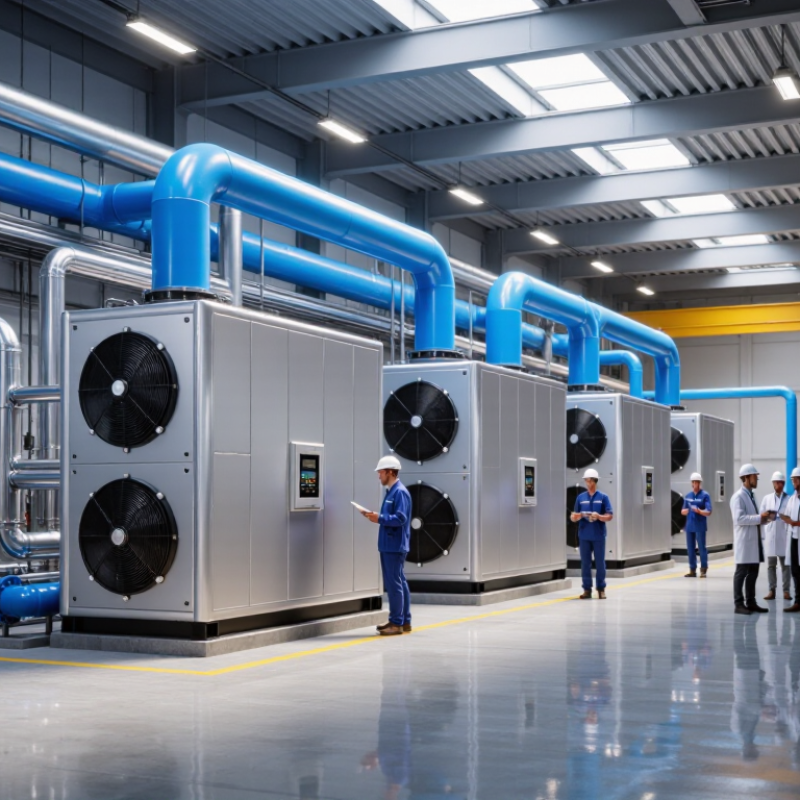
Define Your Business’s Water Chilling Requirements
Before choosing a water chiller, define what your business actually needs to cool. Separate process cooling from comfort cooling, because their temperatures and operating schedules differ. Record the required supply-water temperature, return temperature, flow rate, and heat load. A small temperature error can affect production quality.
Calculate the cooling load during the hottest expected conditions. The basic relationship is cooling capacity = 4.186 × water flow × temperature difference. Use kilowatts when flow is measured in kilograms per second. Include pumps, motors, lighting, people, and heat entering through doors or walls. The ASHRAE Handbook recommends evaluating real operating conditions, not relying only on nominal ratings. The International Energy Agency reports that cooling represents nearly 10% of global electricity use. Efficiency deserves attention, especially for systems running continuously. A neat spreadsheet can still miss short production peaks.
Tips: Measure actual temperatures for several operating days. Ask whether the chiller must run overnight or seasonally. Check water quality, available floor space, noise limits, and electrical capacity. Leave practical room for future expansion, but avoid buying excessive capacity. Oversizing may cause short cycling, poor humidity control, and unnecessary energy use. Request performance data at your design temperatures, not only standard test conditions. Recheck the assumptions with an experienced technician; this step is often skipped.
How to Choose the Right Water Chiller for Your Business? - Define Your Business’s Water Chilling Requirements
| Business Application | Typical Cooling Load | Required Water Temperature | Typical Temperature Stability | Typical Water Flow | Recommended Chiller Configuration | Sizing and Selection Considerations |
| Small Process Cooling | 2–10 kW | 10–20°C | ±1.0°C | 10–40 L/min | Packaged air-cooled chiller with an integrated pump and reservoir | Confirm available power, installation space, ambient temperature, and required pump pressure. |
| Plastic Injection Molding | 10–150 kW | 7–18°C | ±0.5–1.0°C | 40–400 L/min | Industrial air-cooled or water-cooled chiller with a process pump | Calculate heat from mold circuits, hydraulic pressure loss, production duty cycle, and seasonal ambient conditions. |
| Laser Equipment | 3–80 kW | 18–25°C | ±0.1–0.5°C | 8–120 L/min | Precision chiller with closed-loop control, filtration, and flow monitoring | Prioritize temperature stability, water quality, low vibration, alarm outputs, and continuous-duty operation. |
| Food and Beverage Processing | 20–300 kW | 1–15°C | ±0.5–1.0°C | 80–800 L/min | Sanitary-compatible system or packaged industrial chiller with a plate heat exchanger | Specify whether the chilled water contacts the product, then verify materials, cleanability, redundancy, and hygienic requirements. |
| Commercial HVAC | 50–1,000 kW | 6–12°C supply water | ±1.0–2.0°C | 150–3,000 L/min | Air-cooled or water-cooled modular chiller with variable-flow pumping | Compare part-load efficiency, outdoor conditions, water availability, noise limits, controls integration, and maintenance access. |
| Metalworking and Machine Tools | 10–250 kW | 15–25°C | ±0.5–1.0°C | 30–600 L/min | Industrial chiller with a robust pump, tank, filter, and oil-separation provisions | Account for machine heat rejection, cutting-fluid contamination, peak loads, filtration, and required pressure at the tool. |
| Data Center Cooling | 100–2,000+ kW | 7–18°C supply water | ±0.5–1.0°C | 300–6,000+ L/min | Modular, duty/standby chiller plant with redundancy and automatic changeover | Define uptime targets, redundancy level, free-cooling potential, water treatment, emergency operation, and monitoring requirements. |
Preliminary sizing note: Cooling capacity can be estimated using Q = m × Cp × ΔT. For water, 1 L/min cooled by 1°C removes approximately 0.0698 kW of heat. Select the final chiller after confirming the measured heat load, entering and leaving water temperatures, flow rate, pump pressure, operating schedule, ambient conditions, and an appropriate capacity margin.
Compare Chiller Types and Cooling Technologies
How to Choose the Right Water Chiller for Your Business?
Compare Chiller Types and Cooling Technologies
Choosing a water chiller starts with your actual heat load, not the largest available machine. Air-cooled chillers reject heat through fans and outdoor coils. They usually need less installation work and no cooling tower. However, summer air temperatures can reduce their efficiency. Water-cooled chillers use a condenser, cooling tower, and pump system. They often provide steadier performance in large facilities, but require water treatment and regular maintenance.
Several cooling technologies affect operating costs. Scroll compressors suit smaller, stable loads and offer simple servicing. Screw compressors handle changing demand more smoothly in medium and large systems. Variable-speed drives can reduce energy use during partial-load periods. Free cooling may help when outdoor conditions are cold enough. Yet, it is not useful in every climate. An experienced technician should check entering water temperature, flow rate, humidity, and operating hours before making a recommendation.
Tips: Measure the real cooling demand for at least one production cycle. Leave space around filters, coils, and service panels. Compare seasonal efficiency, not only the purchase price. Ask for noise data if the chiller sits near offices. Review water quality before choosing a water-cooled design. Small mistakes matter. I have seen systems sized for peak demand, then running inefficiently for most of the year. A modest safety margin is sensible, but excessive capacity can waste energy and money.
Evaluate Capacity, Efficiency, and Operating Costs
How to Choose the Right Water Chiller for Your Business?
Capacity should match the real cooling load, not a sales estimate. Measure peak heat from equipment, lighting, people, and outdoor conditions. Then add a modest safety margin, usually 10–15%. Oversizing seems safe, but it can cause short cycling and poor humidity control. Undersizing creates hot production areas and expensive emergency operation.
Efficiency matters most during part-load hours. The International Energy Agency reports that space cooling used nearly 10% of global electricity in 2016. Its Future of Cooling report also projects cooling demand could more than triple by 2050. Compare full-load efficiency and integrated part-load values, not one attractive rating. Check water temperature, flow rate, condenser conditions, and seasonal performance. A chiller with variable-speed compressors may reduce energy use when demand changes, but savings depend on controls and maintenance. This part is often underestimated.
Tips
Review twelve months of utility bills. Ask for performance data at your actual entering and leaving water temperatures. Calculate operating cost using local electricity rates, pump energy, water treatment, maintenance, and downtime risk. The U.S. Department of Energy recommends evaluating lifecycle cost rather than purchase price alone. Include operator training and filter cleaning. Small details matter. I would also challenge every projected saving; laboratory figures rarely match a dusty plant room.
Select a Reliable Supplier and Finalize Your Chiller Choice
Choosing the right water chiller depends on more than cooling capacity. A reliable supplier should understand your process, operating temperature, and site conditions. Ask for performance data at your actual inlet and outlet temperatures. A catalogue figure may look impressive, but it can change under summer heat or heavy production loads.
Check the supplier’s technical experience before discussing price. Request installation references from similar facilities, service response times, and maintenance procedures. A trustworthy supplier should explain compressor protection, water quality requirements, noise levels, and expected energy use. Ask for test records, warranty terms, and spare-parts availability in writing. Vague answers are warning signs.
Small details matter.
Before finalizing your chiller choice, compare the total operating cost, not only the purchase quote. Review pump power, cleaning frequency, filter replacement, and technician access. Visit the proposed installation area with the supplier’s engineer. Measure door widths, drainage points, ventilation space, and electrical capacity. I once underestimated maintenance clearance; the unit worked, but servicing became unnecessarily difficult. That mistake deserves attention.
Allow a modest capacity margin, but avoid excessive oversizing. An oversized chiller may cycle frequently and waste energy. Ask the supplier to confirm the selection with a written load calculation. Include delivery dates, commissioning steps, acceptance tests, and training in the contract. A dependable partner welcomes careful questions. The final decision should feel technically justified, serviceable, and realistic for your daily operation.
How to Choose the Right Water Chiller for Your Business?
Compare indicative annual electricity costs before finalizing your chiller choice. The comparison assumes a 100 kW cooling load, 4,000 operating hours per year, an electricity price of $0.12 per kWh, and representative full-load COP values.
Supplier and final selection checklist: Confirm the supplier’s documented COP and part-load efficiency, after-sales response time, spare-parts availability, installation capability, warranty terms, water-quality requirements, and compliance with applicable safety and efficiency standards. Actual costs vary with climate, entering and leaving water temperatures, load profile, maintenance, and local electricity prices.